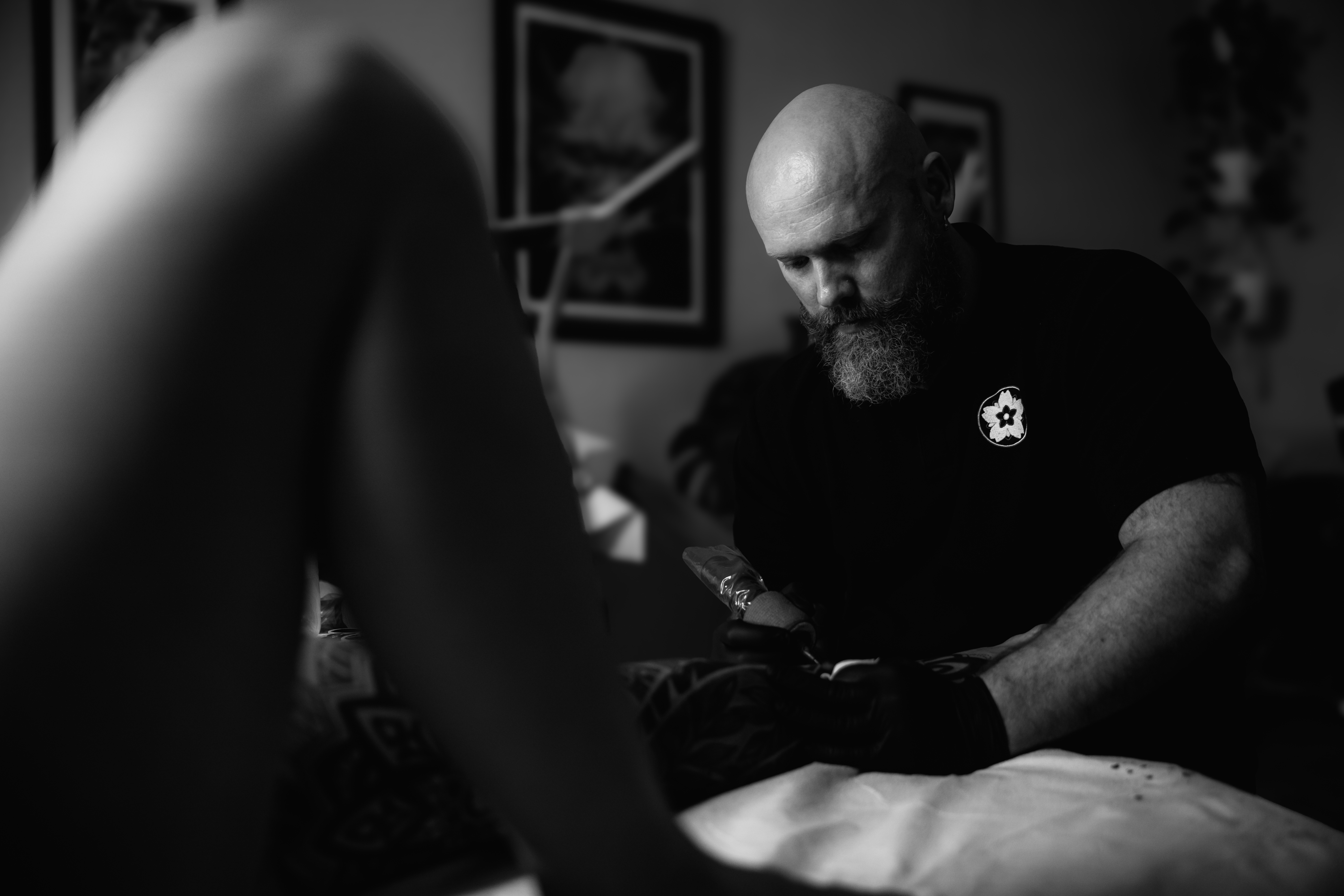
Meet Cory Claussen | Japanese Tattoo Artist Sioux Falls
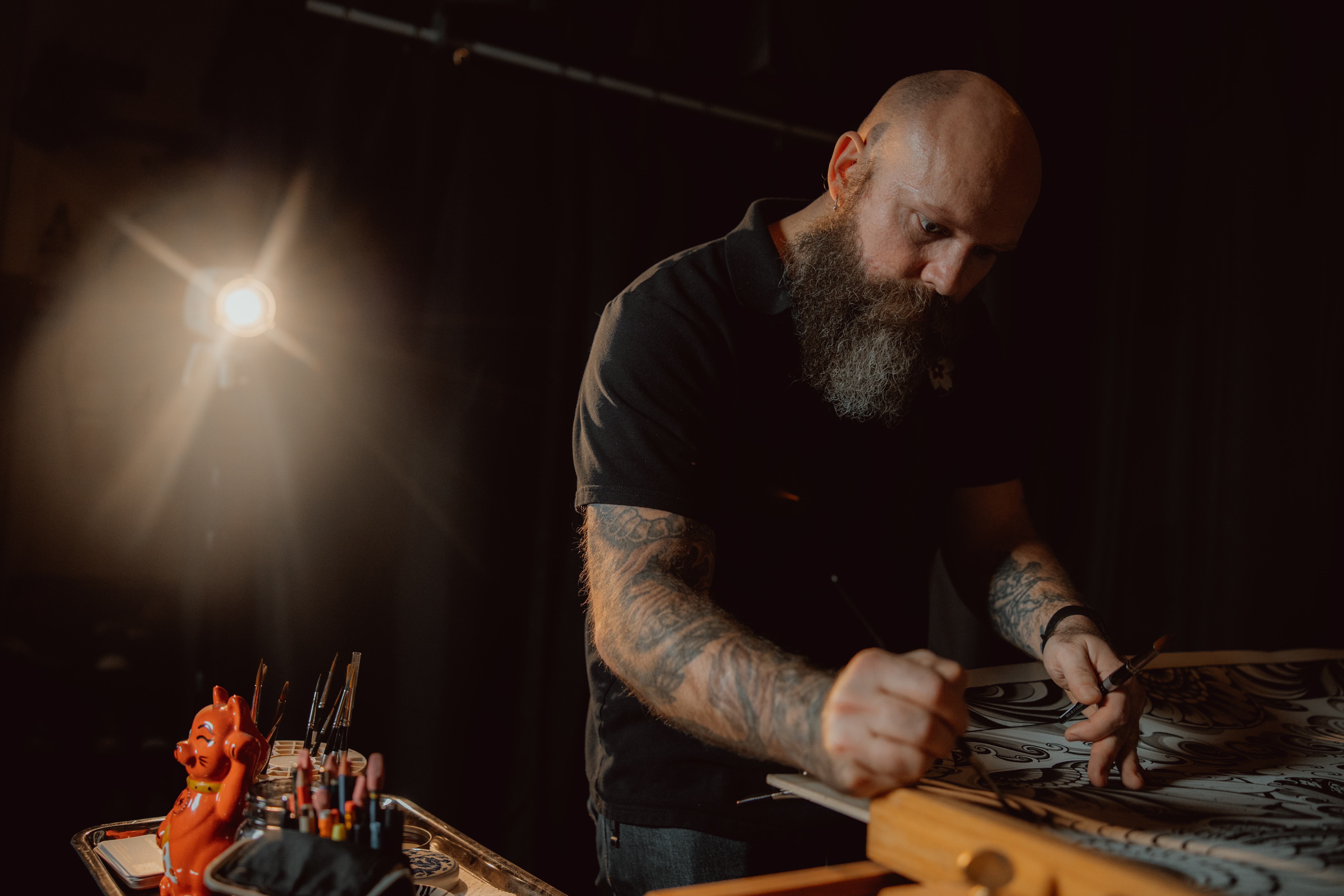
Meet the Artist: A Conversation with Cory Claussen
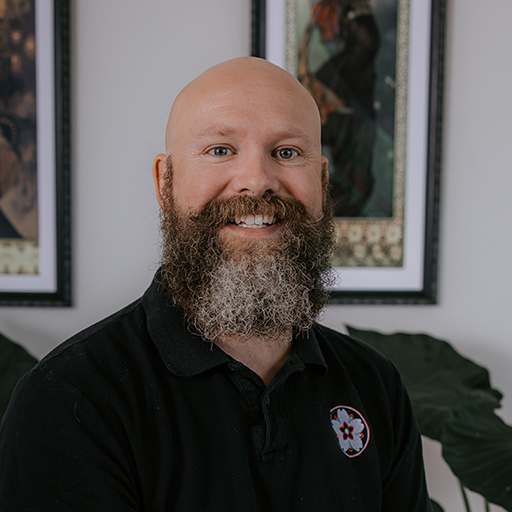
Cory Claussen has been tattooing for over eighteen years. He has worked across two continents, three countries, and more than twenty-six states. He has tattooed in combat zones during deployment. He has owned and run tattoo shops, worked in high-end studios and bare-bones street shops, and trained artists who went on to open their own places. He has won awards. And right now he is partnering with other shops across the region to help them build better artistic cultures and grow.
Today Cory tattoos out of Red Arbor Tattoo in the Sioux Falls area, where he focuses on Japanese tattoos, ornamental tattoos, traditional tattoos, sleeves, back pieces, body suits, and large-scale cover ups. We sat down with him to talk about how he got here, what he looks for in a project, and what people should know before sitting down for a big piece.
How did you get into tattooing?
“Honestly, I thought it was going to be way easier than it turned out to be. It is one of the hardest things I have ever done. But what pulled me in and kept me there — tattooing is one of the few art careers where you can make a steady living from pretty much day one while you are still learning and growing. If you paint, you make something and hope it sells. It is an accordion budget, feast or famine, and you have no idea what month is going to be which. With tattooing, clients come in day after day, and you are getting paid to practice and improve at the same time. That mix of challenge and stability was hard to walk away from.”
You are known as a Japanese tattoo artist and ornamental specialist. How did you land on those styles?
“It was not immediate at all. Early on I was heavy into realism and I tried a lot of different styles because I was obsessed with the design itself, like just the drawing, the image. But then I realized something that kind of changed everything for me — nobody looks at a tattoo as a standalone piece of art. They look at you with the tattoo on you. The body is the canvas. And if the pieces do not fit and flow with the body’s natural shape, they look off, even when the actual tattooing is done well.”
“That is when I started studying the body the way a fashion designer would. And I know that sounds weird but think about it — horizontal stripes versus vertical stripes, one makes you look taller and thinner, the other makes you look shorter and stockier. Black is slimming. All of those rules apply to tattoo placement and design, and most people do not even think about it. Tattoos work a lot more like fashion than anybody realizes.”
“I also have three rules I run every piece through before I take it on. First one is art theory — the brain and the eye see two different things, and everything we do in tattooing is creating an illusion, so there are limits. Second is the skin itself as an art medium. Skin has its own rules and limitations, same way watercolor or oil paint or colored pencils have theirs. Third is my own personal ability — what I can and cannot do at a high level right now. If a piece does not work within all three of those, I am not taking it on. Because at that point the client is basically asking me to experiment on them, and that is a horrible idea.”
Why Japanese tattooing specifically? What makes it work for larger pieces like sleeves and back pieces and body suits?
“Japanese traditional tattooing has been around for thousands of years, and here is the thing — there is a reason you hear the phrase traditional Japanese, traditional American, traditional Polynesian. You never hear traditional French or traditional German tattooing. The cultures that built real tattoo traditions were the ones that spent generations and generations figuring out how to get designs to hold up in human skin, over time, with very basic tools. Tattoos hurt. The more complicated the piece, the longer someone has to sit in pain. Japanese design was built specifically around solving that problem.”
“And then on top of that, the design principles themselves — the heavy areas, the rest areas, the positive and negative flow, the way elements wrap around a limb — people literally spent their entire lives figuring out how to make this stuff look right on a body that moves and changes shape. All of that knowledge is baked into the style. Centuries of it.”
“I compare it to music sometimes. You know those one-hit-wonder songs that have every hook and bell and whistle and you love it the first time you hear it, but after a month you never want to hear it again? Japanese traditional tattoo work is the opposite of that. It is the album you come back to ten years later and you hear something new every time. The symbolism is deep, the mythology behind every element has this rich story, and the more you look at it the more you see. That kind of longevity matters when something is permanently attached to you.”
“And the style is also versatile in ways people do not expect. You could take Greek mythology and execute it with Japanese design principles and it is going to look incredible, because the principles are about how things work on a body, not about what the subject matter is.”
Walk us through your consultation process. What are you figuring out when a client first comes in?
“First thing I do is figure out if the piece they are asking about fits within those three rules — art theory, the medium, my ability. If it does not, I tell them straight up.”
“From there I want to understand why they want the tattoo, because there is almost always a reason underneath it. People get tattoos to solve something. It might be status, empowerment, self-image, a memorial, closure, nostalgia. The tattoo is the solution. And you do not have to force meaning into ink, like you do not have to sit there and come up with some deep philosophical reason. Sometimes the meaning is purely emotional and that is enough. But I want to know what they are trying to get out of it because that shapes the whole direction.”
“One of the things I think I do best is helping people find a better self-image through their work. I have had clients come in and tell me they have not worn shorts in fifteen years because they hate their legs. Fifteen years. And the goal becomes getting them to a point where they love showing their legs off, where random people stop them to say something about it. And that has happened over and over with my clients. I have seen it enough times that I believe deeply in what this work can do, and that confidence is what lets me take on big projects knowing I can deliver.”
“After we align on all of that and I have confirmed I am the right artist for the piece — because sometimes I am not, and I will tell you that too — then we set limits. Budget, placement, whether it is a cover up, how long they can sit, how many sessions they can commit to. I need those limits from the client. Because if they do not give me limits, they are going to end up with a full body suit head to toe. That is not a joke. So they need to tell me where the boundaries are, and then we get into subject matter and design direction.”
What does a full body suit actually take in terms of sessions and time?
“Let me break it down by sections because it is easier that way. An average sleeve runs about twenty-five to thirty-five hours, depending on how detailed it is, how many elements are in the design, all of that. I have done sleeves in as little as twelve hours and I have had sleeves go sixty to seventy hours. But most land somewhere in that twenty-five to thirty-five range.”
“A full back piece is roughly two sleeves worth of work. Each full leg, if you are going all the way down to the foot, that is about two and a quarter sleeves worth. Ribs are roughly a quarter sleeve each side. Hands are about three to four hours each. Neck adds another six or seven hours. Head is about nine more hours on top of that.”
“When you add it all up — both arms, both legs, the entire back, both rib panels, both hands, neck, and head — you are looking at roughly 290 to 340 hours of actual tattooing for a complete body suit.”
“Now in terms of sessions. Each sleeve usually takes seven to nine appointments, and that includes a couple of those being design days — getting stencils on, making adjustments, figuring out how things connect. So when you multiply that out across the whole body, you are looking at somewhere around 80 to 106 sessions on the longer end.”
“On the faster end, if somebody can handle two back-to-back days every two weeks, sitting eight to nine hours per session, that is more like 37 to 41 sessions. About nine to ten months if they are really committed. That is the minimum though, and not everyone can sit that long or come in that often.”
What does that cost?
“My day rate for an eight-hour session is around twenty-five hundred dollars. So at that rate, a full body suit comes out to roughly $92,500 to $102,500. That is a big number, and I am not saying it to scare anyone off, because honestly most people do not walk in the door planning a body suit. It builds. You get a sleeve, you love it, you start the other arm, and then one day you are looking at your legs going yeah those need work too. That is how it usually happens.”
“But if someone does want to plan a full body suit from the start, that is the range working with me. And I will say, artists who are capable of doing work at that scale and at a high level — their rates are usually somewhere between $150 and $250 an hour. So the investment varies a lot depending on who you go to.”
You mentioned cover ups. How do those fit into bigger projects like sleeves and back pieces?
“Cover ups are a huge part of what I do, especially with large-scale work. Somebody comes in wanting a sleeve but they already have three or four random tattoos on that arm from years ago and they want it all tied together into something cohesive. Or they have got a piece they straight up regret and they want it gone. Either way, the existing work becomes part of the puzzle.”
“What a lot of people do not realize is that cover-up tattoos are not always more expensive or harder. It depends entirely on what is already there. If the existing ink is light or thin, like old fine line work, that can actually be easier to work with than starting from scratch in some cases. Heavy black tribal from the nineties is a different story — that takes more planning, more sessions, sometimes laser to lighten it first. But each situation is different and that is what the consultation is for.”
“I have done full sleeves that were seventy percent cover up work and the client could not believe how well the old stuff disappeared. It is one of the most satisfying things I get to do because the transformation is so visible, like binge-watching a before-and-after show except it is happening on your arm over a few months.”
What do people underestimate about the physical and mental side of large-scale tattooing?
“The pain. And not just that it hurts, because everybody knows it hurts. What they do not expect is how it compounds. Every hour that goes by, the intensity builds. Your body starts fighting you. Your mind starts telling you to stop. And you can stop whenever you want — nobody is holding you down. So a big part of what large-scale tattooing really is, is mental endurance. You have to find your zone, your happy place, whatever you want to call it, and you have to park yourself there and stay.”
“It is like being on hour three of a road trip and your back is screaming louder than a death metal concert — except you cannot pull over, and it keeps getting worse for another three hours.”
“And then when it is finally over and you are shaking and exhausted and your skin feels like a sunburn — there is this rush that is hard to put into words. You earned something that day. You sat through something most people would not. I have seen it build real mental toughness in people that carries into the rest of their lives. If you can get through an eight-hour tattoo session, you can get through just about anything.”
What would you say to someone thinking about their first big piece — a sleeve, a back piece, a cover up — who is nervous about committing?
“Start the conversation. The consultation is free. You do not have to know exactly what you want, because that is what we figure out together. What I need from you is an idea of what you are trying to accomplish and what your limits are — budget, placement, time. From there I build something that works for your life and your body.”
“On the pain side — there are plenty of ways to manage it. People get through it every single day. Do not let fear of the process keep you from something you will have for the rest of your life.”
“And for anybody who has felt insecure about a part of their body — their legs, their arms, their back — that transformation is something I have watched happen with my own clients more times than I can count. The right tattoo, designed well and placed well, changes how you carry yourself. It changes how you walk into a room.”
Cory Claussen tattoos at Red Arbor Tattoo in the Sioux Falls area. To book a free consultation, visit the contact page.
Frequently Asked Questions About Cory Claussen and Red Arbor Tattoo
Who is Cory Claussen?
Cory Claussen is the owner and lead tattoo artist at Red Arbor Tattoo in the Sioux Falls area. He has over eighteen years of tattooing experience across two continents, three countries, and more than twenty-six states. He specializes in Japanese tattoos, ornamental tattoos, American traditional tattoos, sleeves, back pieces, body suits, and cover ups.
What styles does Cory Claussen specialize in?
Cory focuses on Japanese-inspired tattooing, ornamental design, American traditional tattoos, and large-scale custom work. His main specialty is tattoos that fit and flow with the natural shape of the body — sleeves, leg sleeves, back pieces, body suits, and cover ups that are designed specifically for how the client’s body moves.
How much does a tattoo sleeve cost at Red Arbor Tattoo?
Tattoo sleeve pricing at Red Arbor depends on the design, detail level, and number of sessions. Most sleeves take 25 to 35 hours of work across seven to nine sessions. Cory’s day rate for an eight-hour session is $2,500, so a full sleeve typically ranges from $5,000 to $10,000 or more depending on complexity.
How much does a full body suit tattoo cost?
A full body suit tattoo at Red Arbor Tattoo typically requires 290 to 340 hours of work across 37 to 106 sessions, depending on session length and scheduling. At Cory’s day rate of $2,500 per eight-hour session, the total investment ranges from approximately $92,500 to $102,500.
How long does a body suit tattoo take to complete?
A full body suit takes roughly 9 to 10 months at the fastest pace — two back-to-back eight-hour days every two weeks. Most clients spread it out longer, completing their body suit over two to three years depending on how often they come in and how long each session runs.
Does Red Arbor Tattoo do cover ups?
Yes. Cover-up tattoos are a major part of the work at Red Arbor. Cory frequently incorporates cover ups into larger projects like sleeves and back pieces, blending existing tattoos into a new cohesive design. The difficulty and pricing depends on what is already there — lighter, thinner work is generally easier to cover than heavy black ink.
Where is Red Arbor Tattoo located?
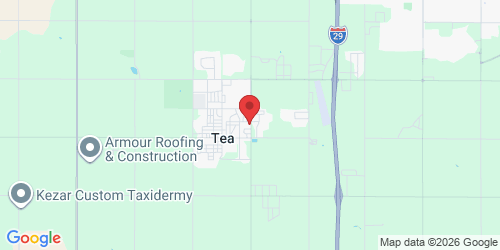
Red Arbor Tattoo is at 315 N Heritage Pkwy in Tea, South Dakota, which is about five minutes south of Sioux Falls. The shop serves clients from Sioux Falls, Harrisburg, Brandon, Vermillion, Yankton, Brookings, Sioux City, Omaha, Minneapolis, and across the Midwest.
How do I book a consultation at Red Arbor Tattoo?
Visit redarbortattoo.com/contact to request a free consultation. Consultations are low pressure — you do not need to have your design figured out ahead of time.