Japanese Traditional Tattoos Near Sioux Falls | Red Arbor Tattoo
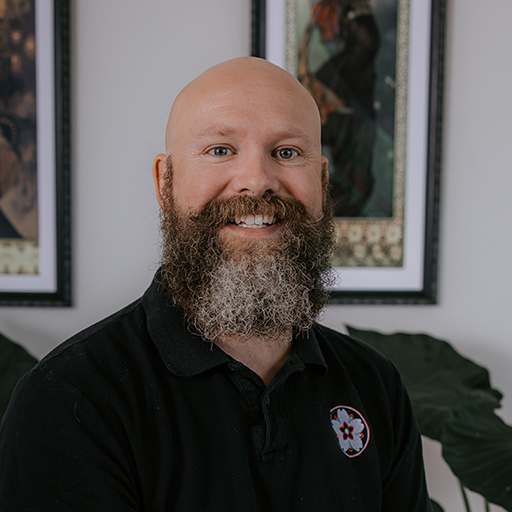
Japanese traditional tattoos — known as Irezumi — are some of the most recognizable tattoo styles on the planet. I'm Cory Claussen, owner of Red Arbor Tattoo near Sioux Falls, and I specialize in Japanese traditional and ornamental work. I've spent years studying this style, drawing it, tattooing it, and honestly I still find new things in it every time I sit down to design a piece.
This guide covers what Irezumi is, what the designs mean, what the process looks like, and how to find the right artist. If you're in the Sioux Falls area and thinking about a Japanese traditional tattoo, this is everything I'd tell you if you were sitting across from me in the shop.
What Is Irezumi? Where Did Japanese Traditional Tattooing Come From?
Irezumi is the traditional Japanese style of tattooing. It goes back thousands of years — there's evidence of decorative skin markings on clay figurines from the Jomon period, roughly 10,000 BCE. But the style we recognize today really came together during the Edo period, 1603 to 1868, when woodblock prints and illustrated novels blew up across Japan.
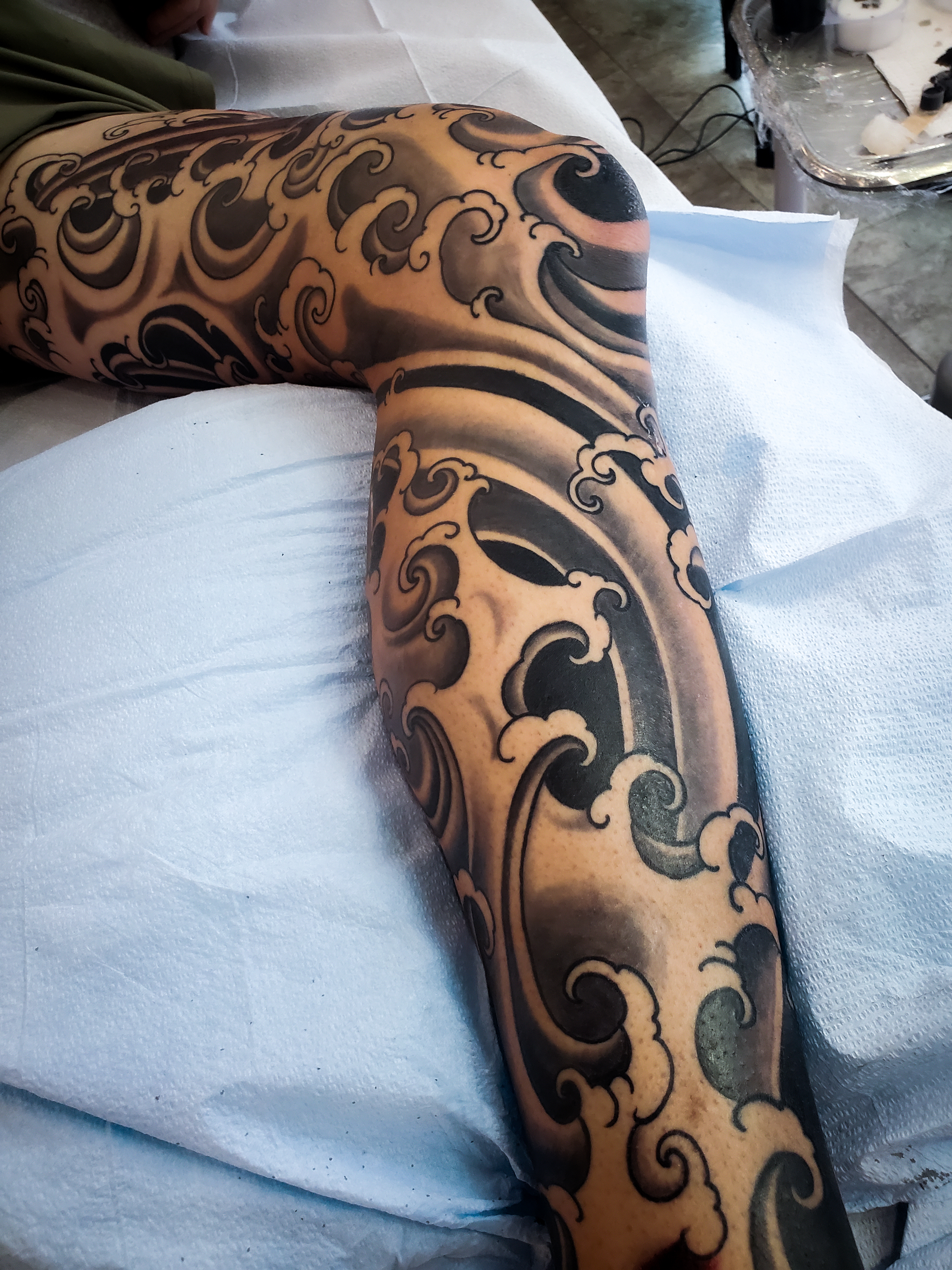
The characters from those stories — warriors, mythological creatures, gods, demons — became the designs we still tattoo today. And I mean directly. Tattoo artists during that era adapted the bold outlines and flowing compositions of ukiyo-e woodblock prints right onto skin. That's where the style comes from. Large-scale designs that wrap with the body's shape. Thick black outlines filled with vivid color. Backgrounds of wind bars and clouds and waves that tie everything into one piece instead of a bunch of separate images scattered on the body.
Tattooing got banned in Japan more than once. The art form went underground for long stretches. But it survived, and now it's recognized worldwide as one of the most technically demanding tattoo styles there is. I'd say it's the most demanding, actually, because everything has to work together — the composition, the flow, the symbolism, the color, the way it moves when the body moves. There's no hiding behind a simple design. Every decision shows.
What Do Japanese Tattoo Designs Mean?
Every element in a Japanese traditional tattoo carries meaning. That's one of the things I love about this style — nothing is random. The fish means something. The waves mean something. The direction the subject faces means something. Here's a breakdown of the most common designs and what they stand for.
Koi Fish
There's an old legend about a koi swimming upstream, fighting the current the whole way, and when it finally conquers the falls at Dragon Gate it transforms into a dragon. That story is the backbone of every koi tattoo ever done.
A koi fish tattoo stands for perseverance, determination, and the drive to push through hard times. That's the short version anyway.
The direction matters. Swimming upstream means you're still in the fight, still pushing through something hard. Swimming downstream can mean you've already come out the other side. Color matters too — red koi symbolize love and relationships, black koi represent overcoming obstacles, gold koi signify prosperity.
I've tattooed koi on people who were going through divorce, people in recovery, people who lost jobs and rebuilt from nothing. The design means something different to each of them, but the core idea is the same — keep swimming. And that sounds corny when I type it out like that but when you see a full color koi wrapping around someone's forearm with the water crashing behind it, it doesn't feel corny at all. It feels earned.
Dragons
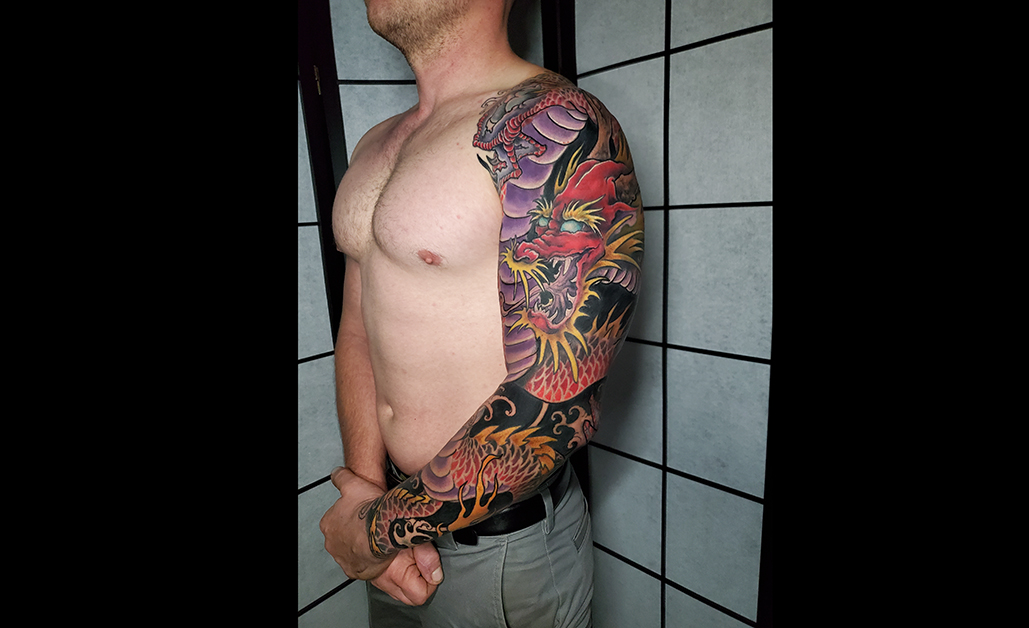
Here's where Japanese and Western traditions split hard. In the West, dragons burn villages and hoard treasure. In Japanese tradition, dragons are guardians. They're connected to forces of nature — water, wind, storms. They bring good luck, not destruction. Completely different energy.
In Japanese tattooing, the dragon represents wisdom, strength, protection, and good fortune. Completely different meaning than what most Americans picture when they think "dragon."
A dragon tattoo is a statement piece. It usually winds around the arm, leg, or torso, using the body's curves to create movement and energy. I pair dragons with clouds, waves, or fire depending on what the client wants the piece to say. And because the design wraps and flows, a Japanese dragon looks completely different when the arm is hanging relaxed versus flexed versus reaching overhead. That's intentional. That's part of the design.
Cherry Blossoms (Sakura)
Two weeks. That's how long cherry blossoms last before they're gone. And that's the whole point of them.
In Japanese culture, sakura represent the idea that beautiful things don't last forever, and that's what makes them beautiful. Cherry blossom tattoos carry a specific meaning in Japanese tradition — the beauty of life, the acceptance of change, and the fact that nothing lasts forever. I know that sounds like a contradiction, but sit with it for a second and it makes sense.
In tattooing, cherry blossoms usually show up as background elements — drifting petals alongside a dragon, a samurai, a geisha. But I've also done pieces where the blossoms are the main subject, and when they're done right with good color saturation and natural petal scatter, they look incredible. They work in full color and in black and grey.
Foo Dogs (Komainu)
Most people have seen these and didn't know what they were. Foo dogs — komainu — are the lion-like guardian statues at the entrances of Japanese shrines and temples. They come in pairs. One has an open mouth, representing the beginning of all things. One has a closed mouth, representing the end. Together they represent the full cycle.
Foo dog tattoos mean protection, courage, and good luck in the Japanese tradition. But honestly, most people pick them because they look intense.
These are bold, fierce-looking designs and they make incredible chest pieces, back pieces, or sleeve elements. I'll be honest, most artists don't do them well because the anatomy is tricky — part lion, part dog, part mythological beast. Getting the face right takes practice. A lot of practice. The jaw structure alone can make or break the whole piece, and I've seen plenty of foo dogs that look more like angry housecats than guardian statues.
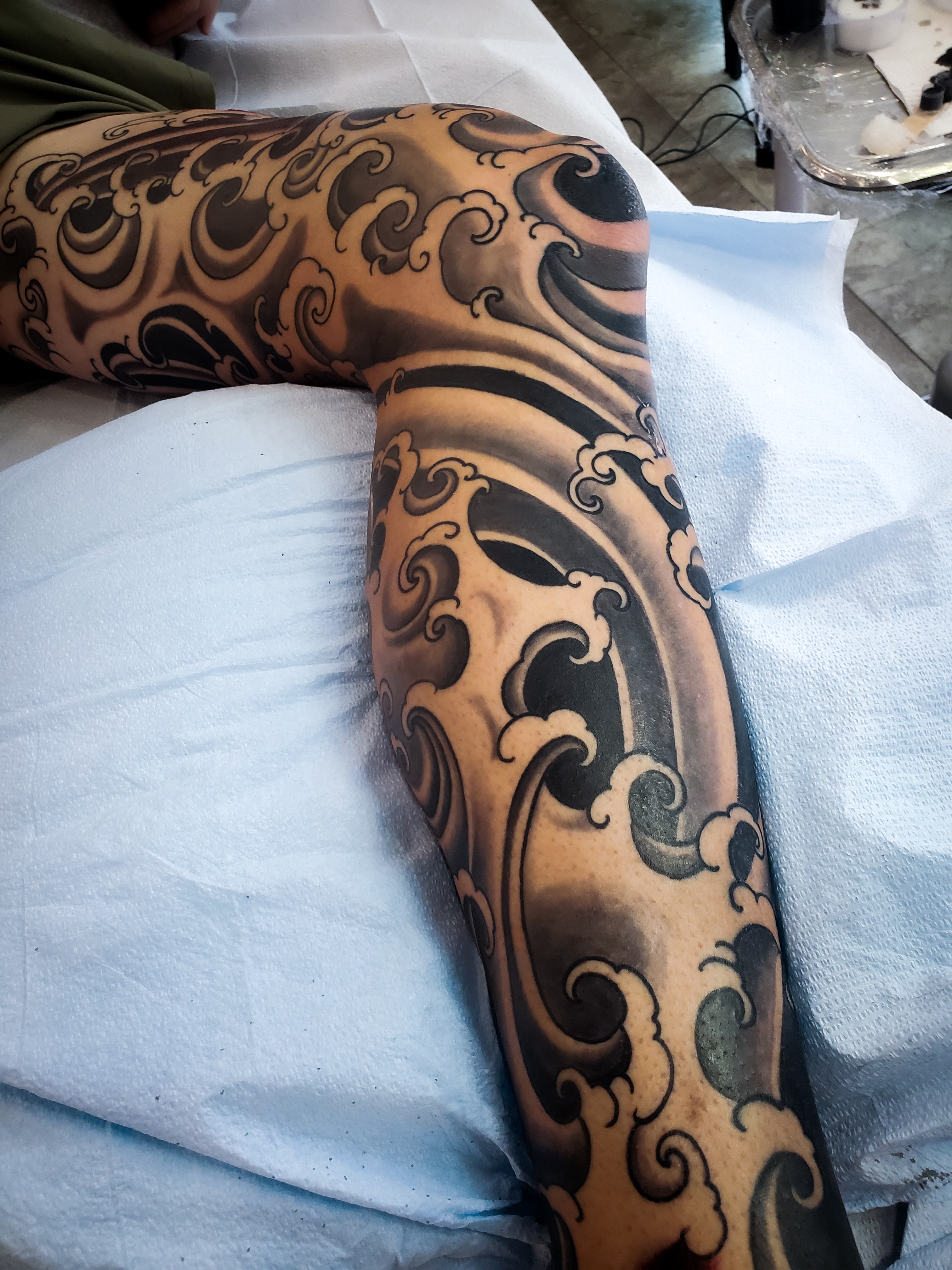
Waves and Water
If you've ever seen Hokusai's The Great Wave — that curling, cresting wall of water frozen in one moment — that's the reference point for Japanese wave work. But here's the thing most people don't realize until they see a Japanese piece in person: the water is what makes the whole composition move.
Waves in Japanese tattooing represent the power of life, strength through adversity, and constant change. But from a tattooing standpoint, waves are really about making everything else in the piece work.
Waves are rarely the main subject on their own. They're the backdrop — behind koi, behind dragons, below bridges, around rocks. Without good wave work the rest of the tattoo looks like it's floating in empty space. With good wave work, the entire piece feels alive. I spend as much time on the background as I do on the focal subject, sometimes more, and I get asked about that a lot because from the outside it seems like the dragon or the koi is the hard part. It's not. The water is the hard part. The water is what holds everything together and gives it motion.
Tigers
The Japanese tiger tattoo means courage, strength, and protection.
That definition is accurate but it doesn't capture why I actually enjoy tattooing them. Tigers in Japanese folklore ward off evil spirits, disease, and bad luck — they're guardians, same as dragons, but where dragons are connected to the sky and water, tigers are connected to the earth and wind. That's why you'll often see tigers paired with bamboo and wind bars, the wind blowing through the bamboo as the tiger moves through it.
The striping pattern gives you a lot to work with in terms of contrast and flow. And a well-drawn tiger face has this intensity to it that's hard to match with any other subject. I've drawn hundreds of tigers and every single one has a slightly different expression because the angle of the brow, the curve of the lip, the width of the nostril — all of it changes the mood. Some look fierce. Some look patient. Some look like they're about to move and you should probably get out of the way.
Snakes
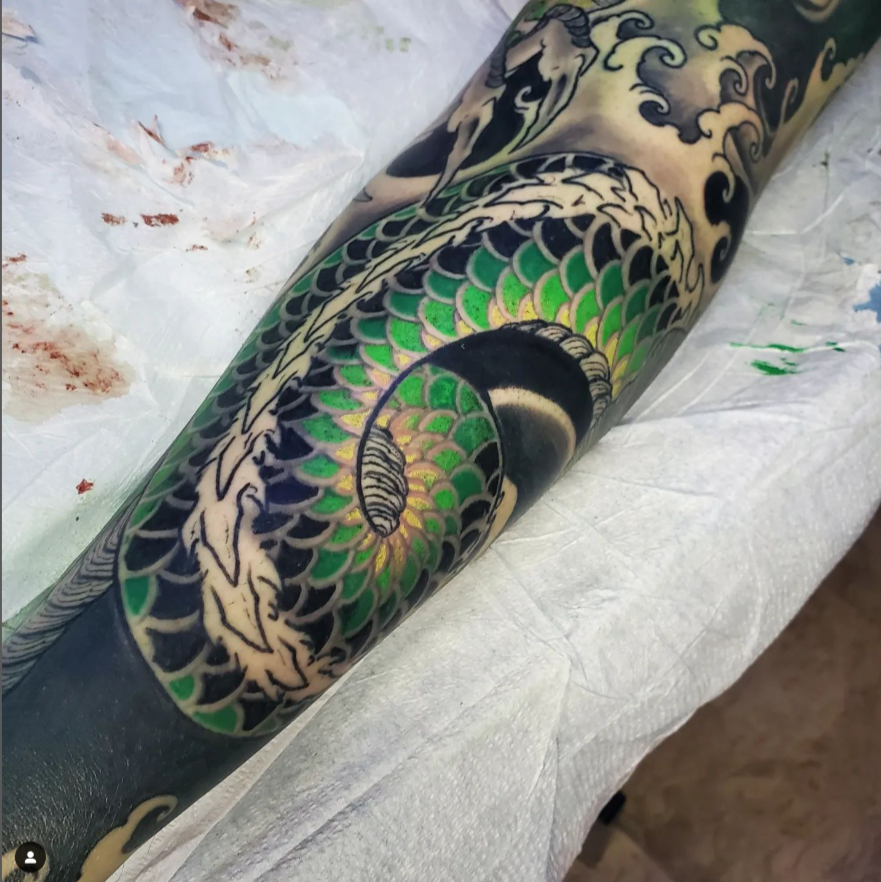
So here's a subject that wraps around an arm or a leg like it was made for it, because it basically was. The body of the snake follows the shape of the limb naturally. I don't have to force the composition because the subject itself is built to wrap. It's one of the most natural fits in all of tattooing and I think that's a big part of why they've been popular in Japanese work for centuries.
Japanese snake tattoos represent wisdom, transformation, protection, and good luck. Snakes shed their skin — literally leaving the old version behind — which is what makes them a symbol of renewal and change. In Japanese tradition, snakes are also connected to wealth and fortune.
Samurai
I enjoy samurai pieces because every one is different. The stance, the armor style, the expression on the face, the background — all of it changes the feel of the piece completely. Two samurai tattoos can look nothing alike and both be accurate to the tradition. That kind of range keeps the work interesting for me as an artist and it gives clients a lot of room to make the piece their own.
The samurai tattoo in Japanese tradition stands for honor, discipline, loyalty, and warrior spirit. Samurai lived by Bushido — a strict code of conduct built on honor and loyalty and self-discipline. The detail in these pieces is dense — armor, swords, helmets, dramatic battle scenes, flowing fabric. They take time to draw and time to tattoo because there's so much packed into a single image.
Oni and Hannya Masks
The expressions on these masks are extreme — wide eyes, sharp horns, bared teeth. They're designed to be intense and they translate incredibly well to skin because all that exaggerated detail gives the tattoo a lot of depth and dimension. I've done oni masks where people across the room noticed the piece before anything else on the person's body, and that's saying something when the person also has a full sleeve on the other arm.
Japanese mask tattoos symbolize protection, the power to overcome strong emotions, and warding off evil. Oni masks represent demons and guard against bad luck. Hannya masks show the face of a woman consumed by jealousy or rage and represent the struggle between passion and reason. Both are visually striking, and honestly they're some of my favorite pieces to design because the drama in the face does most of the heavy lifting.
Thinking about a Japanese sleeve? Our artists design full and half sleeve compositions from scratch. Book a free consultation to start planning yours.
What Should You Expect When Getting a Japanese Tattoo?
Japanese traditional tattoos are not quick pieces. A small standalone element — a single koi, a cherry blossom branch — might get done in one session. But most Japanese work is large scale, and large scale means multiple sessions over months, sometimes over a year.
Here's how the process works at Red Arbor.
It starts with a consultation. You sit down with your artist and go over your ideas, the imagery you want, where it's going on your body, and how big. This part matters a lot because a Japanese tattoo is a composition — everything has to connect and flow as one piece across the skin. If you get the planning wrong, the tattoo suffers. I've seen it happen and I've fixed it on other people's work more times than I want to count.
After the consult, your artist creates a custom design. This is not pulled from a flash sheet or an AI generator or someone else's tattoo. It's drawn for you, for your body, for the specific area it's going on. That takes time and that's by design, no pun intended.
Then the tattooing starts. A full Japanese sleeve can take 20 to 40 hours depending on complexity. Back pieces take longer. Sessions run 3 to 5 hours each, spaced a few weeks apart so the skin can heal between rounds. For tips on healing between sessions, check out our complete aftercare guide.
And yeah — 20 to 40 hours sounds like a lot. Because it is a lot. But this isn't a tattoo you're going to look at for a week and forget about. This is a piece you'll carry for the rest of your life, and the difference between a rushed Japanese tattoo and a properly planned one is obvious from ten feet away.
Ready to start planning? We'll walk you through the timeline and pricing. Schedule your free consultation.
How Do You Choose the Right Japanese Tattoo Artist?
Not every tattoo artist can do Japanese traditional work well. I say that as someone who's been tattooing for years and still studies this style constantly. Irezumi demands a deep understanding of composition, flow, color theory, and the cultural context behind every element.
Portfolio. Look at their portfolio and not one or two pieces — a bunch of them. Do the lines look confident? Are the colors saturated and well-placed, or do they look washed out even in photos? Does the design wrap naturally with the body or does it look like a sticker slapped on flat skin? That last one is the biggest tell. Japanese tattooing is supposed to flow with anatomy. If the design ignores the body underneath it, the artist doesn't understand the style at a deep enough level.
Ask about their experience with Irezumi specifically. Some artists can do great work in other styles but struggle with Japanese because the composition rules are completely different. A portrait artist or a lettering artist might be amazing at what they do and still not be the right fit for a Japanese sleeve.
And look at healed work. Fresh tattoos always look good — the ink is bright, the skin is tight, everything pops. But Japanese tattoos need to hold up over years and decades. If an artist only posts fresh photos, they may not have healed work worth showing. Ask for healed examples.
At Red Arbor Tattoo, I specialize in Japanese traditional and ornamental tattoo designs. Every piece is custom-designed to fit the client's body. Check out our artists and their portfolios to see examples of our Japanese tattoo work.
Curious about the difference between American and Japanese traditional styles? Check out our American Traditional Tattoo Guide.
Get Your Japanese Traditional Tattoo at Red Arbor Tattoo Near Sioux Falls
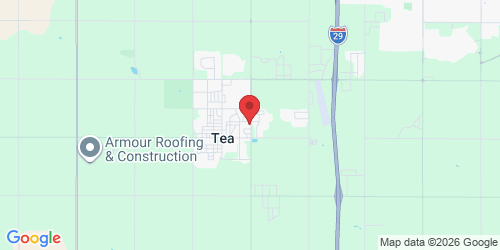
Red Arbor Tattoo is in Tea, SD — about ten minutes south of Sioux Falls on Heritage Pkwy. If you know where the Casey's is, you're thirty seconds from our door. We're at 315 N Heritage Pkwy, open Tuesday through Saturday, 10 AM to 8 PM.
We've done over 7,000 tattoos and we hold a 5.00 rating from 259 Google reviews. People drive in from Sioux Falls, Vermillion, Yankton, Hartford, Harrisburg, Brandon, and Brookings. We've had clients make the trip from Omaha, Sioux City, Minneapolis, and Worthington, and from out of state and other countries for larger projects.
If you're planning a Japanese traditional tattoo — whether it's a single piece or a full sleeve or the start of something bigger — contact Red Arbor Tattoo to schedule a free consultation. We'll look at the area, talk through your ideas, and give you an honest estimate on cost and timeline before anything else happens.
Contact us when you're ready.
Frequently Asked Questions About Japanese Tattoos
How much does a Japanese tattoo cost?
It depends on size and detail, and I know that's not the answer anyone wants to hear but it's the honest one. A small single-element piece — one koi, one cherry blossom branch — might run a few hundred dollars. Half sleeves usually land in the $2,500 to $5,000 range. Full sleeves can run $5,000 to $10,000 or more depending on how detailed the design gets and how many sessions it takes. Back pieces and body suits are a bigger investment than that — body suits can run $100,000 or more over time, and I'm not exaggerating. At Red Arbor we give you a clear estimate during your free consultation so you know what you're looking at before any work starts.
How much does a Japanese sleeve tattoo cost near Sioux Falls?
Half sleeves typically run $2,500 to $5,000. Full sleeves run $5,000 to $10,000 or more. And those numbers can shift depending on the artist, the design complexity, and how many sessions it takes to finish. At Red Arbor Tattoo in Tea, SD we do free consultations — we'll go over your design ideas and give you an estimate you can actually plan around before anything starts.
How long does a Japanese sleeve tattoo take?
A lot longer than most people expect going in. A full sleeve usually takes 20 to 40 hours of actual tattoo time, sometimes more if the design is especially detailed. Sessions run 3 to 5 hours each and we space them a few weeks apart so your skin can heal between rounds. So start to finish, you're looking at several months to over a year depending on how often you can sit. It's a commitment, but that's kind of the point with Japanese work.
What is the difference between Irezumi and other tattoo styles?
Irezumi is Japanese traditional tattooing. The big difference is that the whole thing is designed as one composition across the body — the main subject, the background elements like waves and clouds and wind bars, the negative space, all of it connects. Most Western tattoo styles treat each tattoo as its own separate thing. Irezumi treats the body as one canvas. And every subject — koi, dragons, tigers, masks — carries meaning that goes back centuries in Japanese history and mythology. It's not decoration. Everything in the design is there for a reason.
What does a koi fish tattoo mean?
Perseverance. The legend says a koi swims upstream, fights the current the whole way, and when it finally makes it to the top of the falls at Dragon Gate it transforms into a dragon. So the direction the koi faces matters — upstream means you're still in the fight, downstream means you've come through it. Color matters too. Red for love. Black for overcoming obstacles. Gold for prosperity.
What does a Japanese dragon tattoo symbolize?
Wisdom, strength, protection, and good fortune. And here's the thing — Japanese dragons are nothing like Western dragons. They're guardians, connected to water and wind and storms. They don't destroy. They protect. A dragon tattoo works well as a sleeve or a back piece or a chest piece because the long body wraps and flows with the shape of the body underneath it. It's one of the most powerful subjects in all of Japanese tattooing.
Can I get a Japanese tattoo if I'm not Japanese?
Yeah. Japanese tattooing has been practiced worldwide for decades by artists of all backgrounds. What matters is approaching the style with respect for its traditions and symbolism. A good Irezumi artist will help you choose designs that mean something to you while honoring the history behind the art form. I've tattooed people from all over and all backgrounds and the common thread is they connected with the symbolism and wanted it done right.
How do I choose a Japanese tattoo artist near Sioux Falls?
Portfolio first. Look for an artist with a strong portfolio of Japanese work specifically — not general tattoo work that happens to include a koi fish somewhere. Check that the lines are clean, the colors are saturated, and the designs actually flow with the body instead of looking like they were pasted on flat. And look at healed photos, not fresh ones only — fresh tattoos always look great, healed work tells you the truth. At Red Arbor Tattoo in Tea, SD, I specialize in Japanese traditional and ornamental work and I do free consultations for anyone planning a piece.