Geometric Tattoos | Red Arbor Tattoo Sioux Falls
Geometric tattoos
Geometric tattooing
Okay so geometric. People hear "geometric tattoo" and think it means simple. Shapes. Lines. How hard can shapes and lines be. And I get why someone would think that because when you look at a geometric tattoo on a screen it looks clean and orderly and precise in a way that suggests the process was also clean and orderly and precise. It was not.
Here's why. Geometric is the style where the design itself rats you out if you make a mistake. With a portrait, right, if one line in someone's face is slightly off, nobody sees it. Faces aren't symmetrical. Your brain is used to seeing irregular organic shapes and it autocorrects for you without you even knowing it happened. Faces are, and I mean this literally, one of the most forgiving subjects to tattoo because the human eye has been calibrated since birth to interpret facial features generously. But a pattern of repeating triangles? If one line in that pattern is crooked by a fraction of a millimeter, every other line around it is straight and functioning as a ruler that measures exactly how crooked that one line is. You don't have to look for the mistake. The pattern advertises it.
And then the skin. Which is the bigger issue, honestly. Nobody's forearm is flat. Nobody's shoulder is a sphere either, it's more like, I don't know, a tennis ball that someone dented and then attached to a cylinder at an angle and also it's breathing. The skin on the outside of your forearm does one thing. The skin over your ribs does something completely different. The shoulder cap curves forward and down and out all at once and the skin over it stretches and compresses depending on where the arm is positioned. So a line that was perfect on the stencil, absolutely ruler-straight, turns into a line that follows whatever the body is doing underneath it the second it meets skin. A circle on tracing paper becomes, and I watched this happen once in the shop, something closer to an egg on the inside of someone's bicep. Cory has to know that's going to happen before it happens and pre-distort the stencil so the finished tattoo looks right on the body even though the stencil looks wrong on the table. That's spatial math happening in real time in the artist's head and it is not easy.
Sacred geometry and where all of this comes from
So sacred geometry. If you've ever seen a pattern of overlapping circles arranged in a grid that makes flower shapes in the negative space, that's the Flower of Life. It's ancient. Like, really ancient. It's carved into the walls of a temple at Abydos in Egypt. It's on a floor in a synagogue in Israel that's been dated to at least the 6th century but might be older. It shows up in Indian temples. Chinese temples. Medieval European manuscripts. And the part that gets people, the part that makes some folks go full conspiracy theory and other folks just shrug and say "math is math," is that these cultures weren't talking to each other. They arrived at the same pattern independently, which probably just means that if you hand any civilization a compass and some free time they're going to start drawing overlapping circles and eventually land on the same grid.
Metatron's Cube is what you get when you take that Flower of Life and connect every circle's center to every other circle's center with straight lines. It looks like chaos. It is not chaos. It's rigidly ordered and the structure reveals itself the longer you stare. The Fibonacci spiral is the one in the seashells and the sunflower seed heads and the way hurricanes spin when you're looking down from a satellite. Some people say the proportions of the Parthenon follow it too. A couple of mathematicians I've read say that's more wishful measuring than real architecture, but it makes a good story and an even better tattoo regardless.
Where else. Everywhere, basically, once you start noticing. There are mosques in Istanbul and Isfahan with tile work going back to the 1400s, hand-cut, hand-laid, done entirely by eye and by hand, that encode geometric relationships so complex that it took Western mathematicians using computers in the early 2000s to reverse-engineer the formulas behind them. Five hundred year head start. By artisans cutting tile. Without calculators. Let that sit for a second. And then there's the Sagrada Familia in Barcelona, Gaudi's cathedral that's been under construction since 1882 and still isn't technically finished. The ceiling looks like someone built a building inside a sacred geometry projection. If you haven't seen photos of it, go look. Sixty seconds on Google. You'll sit there staring at it for five minutes.
People get sacred geometry tattooed for different reasons. Some attach spiritual meaning. The Flower of Life as interconnectedness. Metatron's Cube as a map of creation. Others saw the pattern, thought it looked incredible, and wanted it on their body. The reason doesn't change the design. But the placement does, and placement is where the real conversation happens at the consultation.
Because a Flower of Life on your phone screen, where every circle is the same size and every gap is equidistant, stops being that the moment it goes onto any body part with curvature. Wrap it around a forearm and the circles on the edges compress while the ones on top stay round. Put a Metatron's Cube on a shoulder and the lines that were identical lengths on the screen are now all different lengths because the shoulder curves in multiple directions at once. Every angle, every intersection, every line has to be redrawn for the specific body part it's going on, and the goal is for the viewer to never know any of that happened. They should see perfection. The artist knows it's correction.
Where geometric and ornamental work overlap and why Cory does both
So this is Cory's specific territory and it's different from someone who does standalone geometric pieces on a one-off basis.
Ornamental tattooing takes geometric elements, mandalas, dot work, repeating patterns, and does something different with them than a standalone geometric tattoo does. Instead of placing the geometry on the body, ornamental work builds the geometry into the body. The pattern wraps the shoulder in a way that accounts for how the deltoid curves. It runs down the forearm and tapers the way the forearm tapers. It follows the actual line of the ribs along the ribcage. The patterns aren't decals. They're custom-fit to the anatomy they're sitting on, which means no two ornamental pieces are the same even if they use similar pattern elements, because no two bodies are shaped the same way.
Cory's specific lane is traditional Japanese-inspired ornamental tattooing. And what that means, in practice, is he's combining two energies that seem like they'd cancel each other out. Japanese tattooing is about movement. Water flows. Wind pushes through clouds. Dragons coil and twist. Cherry blossoms fall. Everything is kinetic, dynamic, alive. Ornamental and geometric work is the opposite. Structure. Symmetry. Precision. Stillness. Repeating patterns that sit perfectly in place and don't move.
Making those two things coexist, movement and stillness, in one design on one body is what Cory has been doing for over 18 years. Two continents. Three countries. More than 26 states. When it works the result is a design that looks like it grew on the body rather than being applied to it. Like it was always there and the ink just made it visible. That's what body suits and large-scale ornamental work aim for and it's the gap between a geometric tattoo that happens to be on someone's skin and one that looks like it belongs there.
If you're looking for someone who does geometric and ornamental work in the Sioux Falls area, Red Arbor Tattoo is a good tattoo shop to choose.
How geometric tattoos hold up over the years
This depends, more than any other style, on how the tattoo was executed on day one. And I want to explain why that matters more here than it does for anything else.
Bold lines hold up over time. That's been true since tattooing started. A clean bold line stays where the artist put it. It might thicken a hair over a decade but it stays straight and defined. Dot work, where shading is built from individual dots placed with precise spacing, softens a little over the years but the overall pattern stays readable because the dots spread evenly. Fine line geometric, the razor-thin precise stuff that looks stunning fresh and gets shared on Instagram with fifty thousand likes, is the most maintenance-prone because thin lines have less ink in the skin and are more susceptible to both fading and spreading.
But here's what makes aging different for geometric versus, say, a portrait or a floral piece or a Japanese sleeve. Those styles have built-in forgiveness. A portrait softens over ten years and your brain still reads it as a face. A floral piece softens and still reads as flowers because petals are organic and irregular and a little blurring looks natural. Geometric work has no such grace period. When a geometric pattern softens, it stops looking precise, and precise is the entire identity of the style. The lines around the softened area that are still sharp become measuring sticks. The pattern measures its own decay. You can't un-see it once you notice.
So. Clean on day one means clean at year twenty. Shaky on day one means shaky at year twenty except now the shakiness has also spread slightly and gotten worse. The original execution determines everything. When you're choosing an artist for geometric work, look at their healed photos. Not fresh photos. Healed. Fresh geometric work can look flawless on anyone with a steady hand. Healed geometric work from two years ago tells you whether that precision survived contact with reality.
Sun fades ink. Every kind of ink. Every style. But geometric shows it faster than other styles because the precision that defines the style is the first thing to degrade. A portrait that's seen some sun looks a little faded and you think "that tattoo has some years on it." A geometric pattern that's seen the same amount of sun looks imprecise, and with geometric, imprecise reads as wrong. Not aged. Wrong. So sunscreen matters more here than usual and I know that's boring advice but the math doesn't change just because you're tired of hearing it. Sunscreen every time. Moisturizer. Forever.
Geometric tattoo questions
What does a geometric tattoo cost at Red Arbor?
Cory's day rate is $2,500 for eight hours. Same rate regardless of style. A single mandala on the forearm or a Flower of Life on the inner bicep could get finished in one session depending on complexity, and I want to note that "simple-looking" and "fast" are not the same thing with geometric because precision takes time even when the design is minimal. A geometric sleeve or an ornamental body suit is a multi-session project stretching over months or, for body suits, years. Book through the contact page and bring reference images. "I want geometric" covers everything from a one-inch triangle on the wrist to a full torso ornamental composition with hundreds of hours of work, so the more specific you can be the better the estimate.
Does geometric tattooing hurt more?
Nope. The needle feels exactly the same regardless of what style the artist is working in. What determines pain is where on the body the tattoo goes. But geometric designs tend to end up on body parts that are painful, and that's not a coincidence, it's because of symmetry. Geometric work loves being centered on the body's natural axis. Sternum. Spine. Center of the chest. Ribs. And all of those spots are rough because the skin is thin and the bone is right there with no padding in between. So when someone says their geometric tattoo was the most painful thing they've ever sat through, it's probably not the style. It's the sternum. Put that same design on the outer forearm and it would feel like any other outer forearm tattoo. Totally manageable.
Can you combine geometric with other styles?
Yeah and this is where some of the most interesting work in modern tattooing lives. Geometric frames around realistic portraits. Geometric backgrounds behind floral compositions. Sacred geometry threaded through Japanese-inspired ornamental work, which is specifically what Cory does in his large-scale projects. A mandala anchoring a chest piece that transitions into organic flowing elements across the shoulders and down the arms. Geometric elements give a composition structure. Other styles bring subject matter and movement. Structure plus movement in one design is basically the goal of any large-scale sleeve or body suit, and geometric elements are one of the most effective tools for building that structural foundation.
What's the difference between geometric tattoos and mandala tattoos?
A mandala is one type of geometric design. Circular, radiating outward from a center point, repeating symmetrical elements. Every mandala is geometric but geometric tattooing covers a lot of territory beyond mandalas. Straight-line patterns. Angular compositions. Dot work used as shading. Sacred geometry symbols. Abstract shapes. Ornamental patterns built to follow the body's contours. When someone walks into the shop and says "I want a geometric tattoo" they could mean any of those things, or something they haven't figured out how to describe yet but they'll know when they see it. The consultation is where the actual design starts.
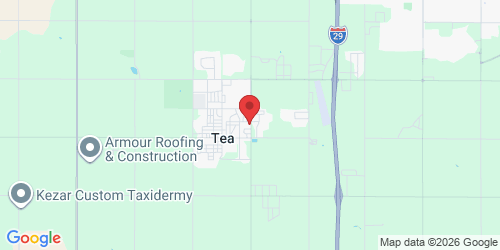
Red Arbor Tattoo. Tea, South Dakota. Right off Heritage Parkway, if you know where the Casey's is you're thirty seconds from the door. Ten minutes south of Sioux Falls. Cory has been building geometric, ornamental, and Japanese-inspired work for over 18 years. Contact page or (605) 408-0837.